DDA C Zone Delhi Localities, Land Use
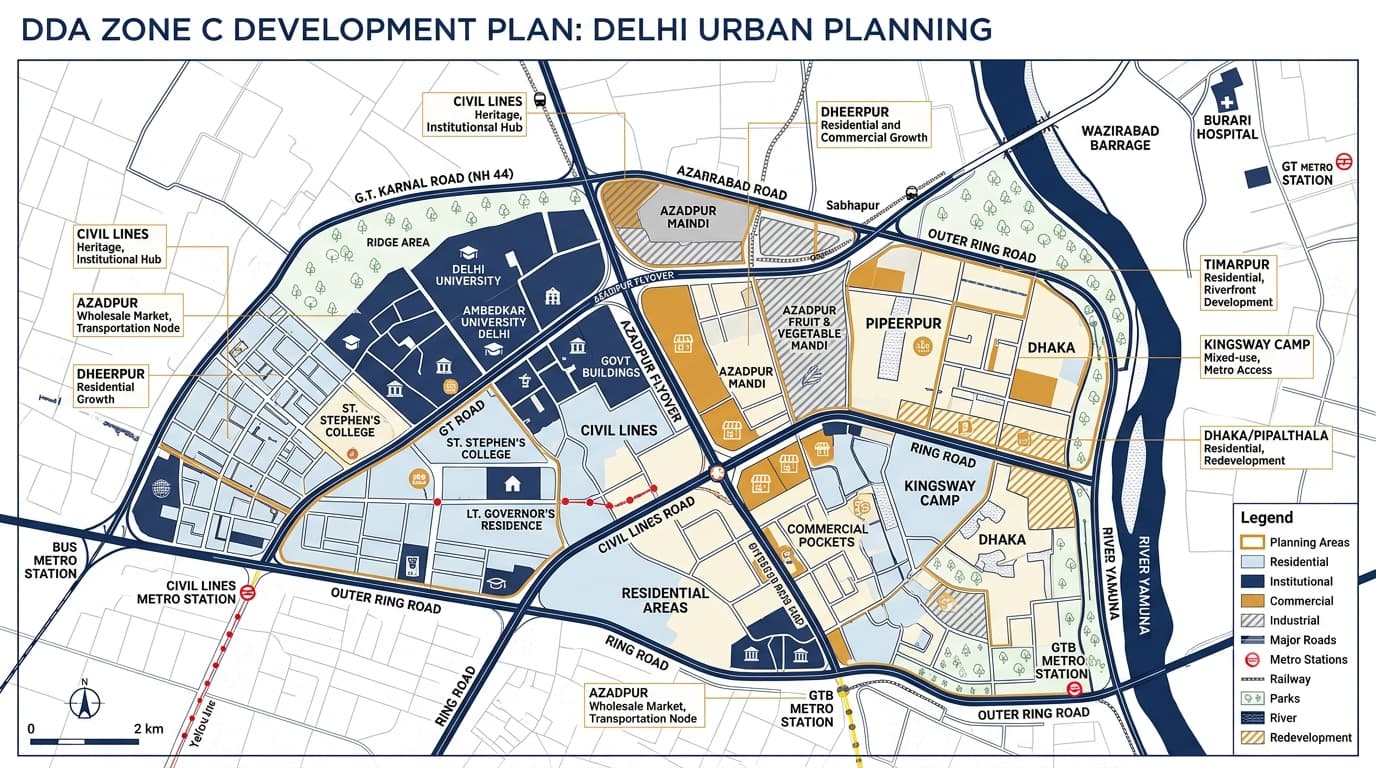
DDA Zone C is the Civil Lines zoning of Delhi that spans about 3,959 hectares in the northern region of the city. The zone contains a mix of old residential areas, campus lands, old gardens, rehabilitation colonies, industrial and commercial enclaves, and transport zones as well as other old planned zones. Some of the important locations related to this particular zoning include Civil Lines, Azadpur, Dheerpur, Pipalthala, Dhaka, Kingsway Camp, and Timarpur.
As DDA Zone C is made up of old residential zones and institutions, as well as markets, transport zones, and rehabilitation zones, it would be useful for property studies to take into consideration specific localities, land use, zoning plans, and development guidelines.
DDA Zone C at a Glance
Zone C has a more varied planning character than a simple residential zone. Civil Lines and surrounding areas contain established residential development, institutional areas and historic open spaces, while locations such as Azadpur and Pipalthala also have commercial, industrial and transportation-related activities.
Areas and Localities in DDA Zone C
The planning zone contains several important established areas. DDA's planning material identifies areas such as Azadpur, Dheerpur, Pipalthala and Dhaka within Zone C.
The exact planning treatment can differ from one locality to another. Therefore, the locality name should be treated as the starting point for research rather than as proof of permitted land use.
Key Planning Characteristics of Zone C
Zone C combines older established development with institutional, commercial and transportation functions.
Established residential areas
Institutional and educational facilities
Historic gardens and open spaces
Rehabilitation and older planned colonies
Commercial and wholesale activity
Industrial pockets
Major roads and transportation corridors
Railway-related infrastructure
Parks and recreational areas
Redevelopment and layout-planning requirements
Mixed urban development around established settlements
The planning character also differs from DDA Zone B, which is associated with Karol Bagh and City Extension. At the same time, Zone C connects with larger northern planning areas associated with DDA Zone P-I and DDA Zone P-II.
Land Use in DDA Zone C
Land use within Zone C is diverse. Residential areas coexist with institutional campuses, commercial activity, industrial pockets, transportation facilities, parks and public infrastructure.
For a property owner or buyer, the surrounding land-use pattern should not be confused with the permitted use of an individual plot. The specific land-use designation and applicable planning documents should be checked. The broader classification can be understood through DDA Land Use in Delhi, while the zone-level planning structure provides the context for understanding how these uses are distributed.
DDA Zone C and Zonal Development Plan
The DDA Zonal Development Plan serves as a planning connection between the Master Plan and Layout Plans. The zonal plan contains details on land use zoning, social infrastructure, parks, open spaces and circulation patterns. However, a land use zoning under a zonal plan doesn’t confer an automatic right on its own to the owner to put it to that specific use.
For Zone C, the planning framework can be used to identify:
Current and intended uses of land
Residential and institutional areas
Commercial and industrial pockets
Circulation patterns
Parks and open spaces
Public and semi public facilities
Transportation network
Considerations for redevelopment and layout
Connection between zone level and property level planning
The broader planning context can also be studied through Delhi Master Plan 2047, while individual property decisions require more specific verification.
Zone C Layout and Sub-Zone Planning
Detailed layout plans are especially important in Zone C because the planning area contains different types of development. DDA's layout records include planning work related to Gujrawala Town, Derawal Nagar, Dheerpur, Kingsway Camp, Hudson Line, Outram Line, Azadpur and other areas.
This makes the detailed layout particularly important when moving from a general Zone C map to a specific property.
DDA Zone C Property Verification
A property should not be evaluated simply because its address falls within Civil Lines Zone. DDA Property Verification should move from the broad zone to the exact property and its applicable planning documents.
Practical Property Research Sequence
Identify the exact property address and locality.
Confirm the applicable Zone C planning area.
Identify the relevant sub-zone or layout.
Check the land-use designation.
Review the applicable layout or development plan.
Examine property and plot records.
Verify ownership and title separately.
Compare existing use with planning provisions.
Review development and building controls.
Check access, infrastructure and redevelopment considerations.
Redevelopment Considerations in Zone C
Zone C has established older sites and planned sites which have been subjected to redevelopment. These can include sites such as Kingsway Camp, established residential sites, and others which may require close scrutiny of the layout plan, existing development, and regulations.
These may include:
Condition of existing buildings
Land use of existing site
Layout/scheme plan
Nature of plot
Road accessibility and circulation
Parking facilities
Utility availability
Land use of neighboring sites
Re-development conditions
Approvals required
An established location should not automatically be considered redevelopment-ready. The actual planning and property conditions need to be assessed separately.
DDA Zone C in the Wider Planning Structure
Zone C is part of Delhi's broader zone-based planning system. Comparing it with other zones helps explain the differences between established central areas and larger urban-extension zones.
Zone C therefore needs to be researched differently from peripheral areas where large-scale urban expansion or land pooling may be a major consideration.
DDA Zone C and Land Pooling
The technique of land pooling has more relation with the following planning contexts in terms of urban extension or periphery planning than the Civil Lines planning context, where the land pooling development was carried out. Those who wish to conduct research on development through pooling should consult DDA land pooling policy for the wider planning context. But, being under DDA planning area does not imply pooling area.
Different Property Situations in Zone C
Common Mistakes While Researching DDA Zone C Property
The assumption that all properties in Zone C have the same land-use zoning.
The assumption that Civil Lines or some other locality name is a proof of use permission.
The ignoring of the relevant layout plan.
The assumption that institutional/commercial use in the neighborhood automatically decides the land use of that property.
The ignoring of transport limitations and infrastructure limitations.
The assumption that redevelopment is assured.
The checking only of an online property listing.
The ignoring of the ownership proof.
The reliance on an old planning map.
The confusion of zonal planning with development permission for the property.
The assumption that land pooling is applicable in all DDA planning zones.
FAQs
What is DDA Zone C?
DDA Zone C is the Civil Lines planning zone of Delhi. It includes established residential, institutional, commercial, industrial, recreational and transportation-related areas in north and north-central Delhi.
What is the approximate area of DDA Zone C?
The zone covers approximately 3,959 hectares.
Which areas are associated with DDA Zone C?
Important areas include Civil Lines, Azadpur, Dheerpur, Pipalthala, Dhaka, Kingsway Camp, Timarpur and other surrounding planning areas.
Is DDA Zone C mainly a residential zone?
No. It contains residential areas as well as institutional, commercial, industrial, recreational and transportation-related uses.
Does being in Zone C automatically allow construction or redevelopment?
No. The applicable land use, layout, property records, development controls, infrastructure conditions and required approvals need to be checked for the individual property.
Why is the DDA Zonal Development Plan important for Zone C?
It connects the broader Master Plan with detailed layout planning and helps explain land use, circulation, public facilities, parks and other planning components within the zone.