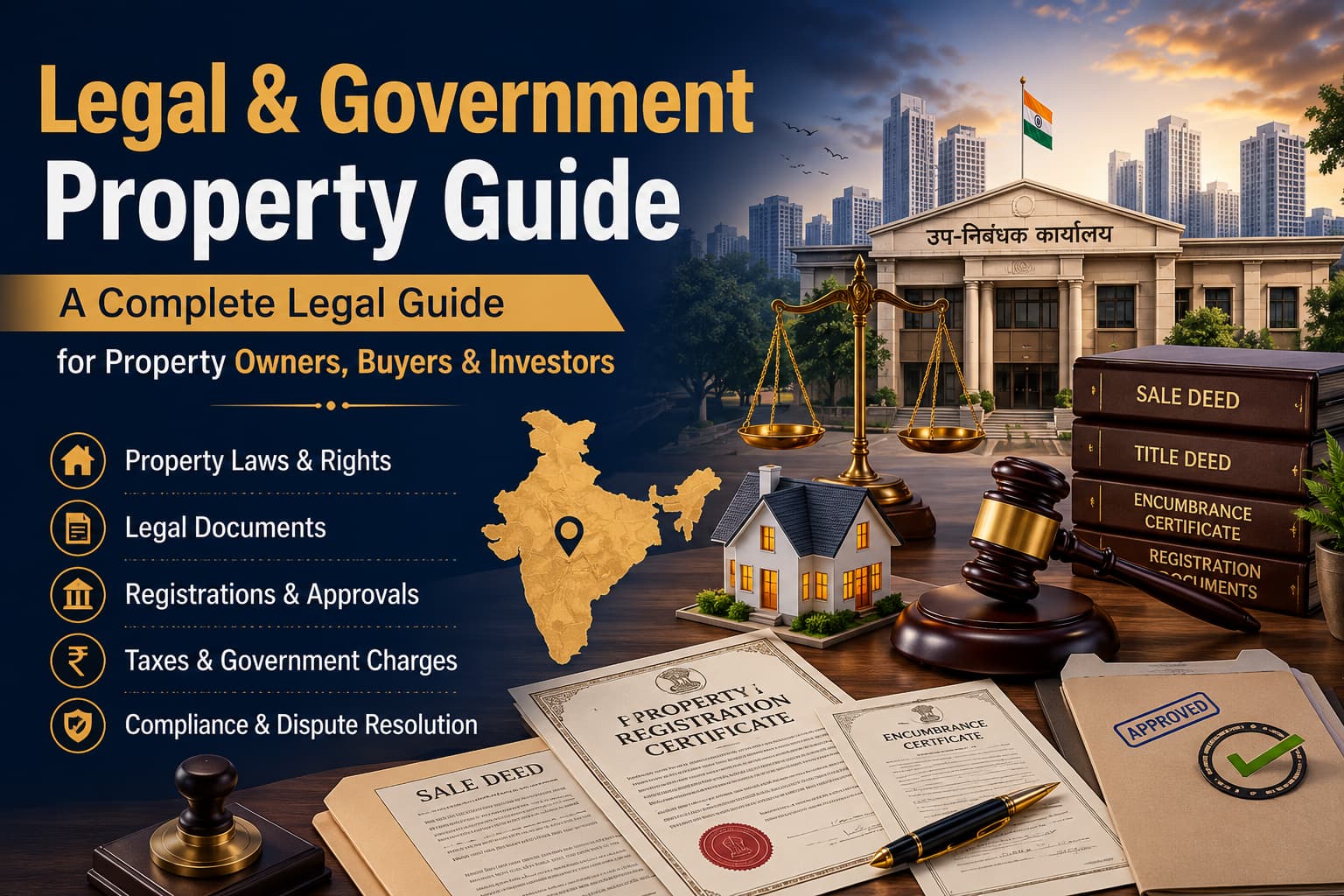
Legal & Government Property Guide
Last Updated: July 11, 2026
Legal & Government Property Guide will provide all the necessary information regarding the legal aspects of buying, selling and ownership of the property in India. In all the cases of property transactions, there are various legal processes, government formalities, documents and statutory obligations which can never be overlooked. The absence of even one document and verification process may cause problems for the future. Whether you want to buy your first home or some piece of land or any commercial property, this guide will provide you with all the necessary information so that you have a complete idea about the legal matters related to property in a convenient way.
Purchase or sale of any property does not only require negotiating its price and executing some paperwork. Each real estate transaction takes place under the conditions provided by the legal system designed for protection of interests of buyers, sellers, lenders and other parties involved in real estate transactions. Legal papers determine ownership of properties, document their transfer, provide proof of statutory approvals and establish an accurate record, which could be used as evidence in case of any future disagreements or further transactions. Thus, understanding of such documents becomes one of the key elements in making a proper real estate purchase.
Documents related to the property play an important role at all stages of its existence. In case of application for a mortgage, selling of the property in future, handing the property over to another person, inheriting the property and dealing with any legal disputes, well-kept records become very valuable. Financial organizations, state bodies, municipalities and courts use official documents rather than oral claims and agreements while determining the ownership.
Not checking the validity of the transaction legally can lead to several risks, including the risk of disputable ownership of the property, undisclosed financial obligations, illegal construction works, lack of proper governmental approvals, ongoing lawsuits, or even fraud. Although the property may look favorable in terms of location or price, the lack of proper documentation will definitely create serious problems in future. It is thus considered to be one of the safest ways to check before paying for a property.
The Legal Property Guide is intended to make this complicated issue much simpler. Instead of studying the various legal issues related to properties separately, the user may first refer to this guide and then proceed to read detailed articles on various property documents, property registration, certificates, governmental approvals, taxation, and housing schemes.
Explore Our Complete Legal Knowledge - Table of Content
Property Registration Guide
Sale Deed Guide
Sale Agreement Guide
Sale Deed vs Sale Agreement
Registry Process in India
Title Deed Guide
Mother Deed Guide
Gift Deed Guide
Lease Deed Guide
Builder Buyer Agreement Guide
Power of Attorney Guide
Conveyance Deed Guide
Will & Succession Certificate Guide
Property No Objection Certificate (NOC) Guide
Relinquishment Deed Guide
Partition Deed Guide
Encumbrance Certificate Guide
Occupancy Certificate Guide
Completion Certificate Guide
Mutation Process Guide
Khata Certificate Guide
Land Conversion Guide
Property Tax Guide
Stamp Duty & Registration Charges Guide
RERA Guide
Government Housing Schemes Guide
Legal & Government Resource
The needs of every property buyer may differ from one another, but the process remains similar, starting with identification of the property and ending up with acquiring possession of it. The sections that follow below provide basic knowledge on the most important issues related to law and government and which every property buyer or seller needs to know before making a single decision about their property.
Knowledge about the process flow of the legal procedures is much easier than looking at each document individually as a procedure. The time line below is an illustration of the process that most property purchases in India normally go through in terms of legalities. Although some processes may differ depending on the type of property or state laws, the entire legal process is almost similar.
Every stage shown above contributes to establishing legally recognised ownership. Skipping even one verification step may create avoidable complications during resale, inheritance, financing, or future ownership transfers. Following a structured legal process not only protects buyers from unnecessary risks but also ensures that every important document is collected, verified, and preserved throughout the ownership journey.
Property Buying Legal Journey
It is much easier to buy property if one is aware of the whole legal process from start to finish and does not see every piece of documentation as a single requirement. In the first step, it is necessary to find the proper property and check if the project has all the required approvals. When the initial information is obtained, then it is essential to study ownership papers, title deeds, government registration, approved plans, taxes, and only then make the payment. The next step includes the preparation of the sale agreement, calculation of the required government fees, and completion of property registration. The next action is updating the ownership papers using the mutation procedure and keeping all legal documentation safe. It is worth noting that it is possible to maintain property ownership legally safe through periodic compliance.
Types of Property Documents
The documents related to property can be generally grouped into different types depending upon their utility at various stages involved in the process of buying, selling, constructing and owning property. Knowledge about the categories would assist the buyer in identifying documents related to establishing ownership, documents related to government approval and documents that can be used for further legal or financial transactions. Instead of equal importance to all the documents, the buyer needs to know how to categorize the documents depending upon the total legal system of property ownership.
Documents related to establishment of ownership include documents like Title Deed, Sale Deed, Mother Deed, Conveyance Deed, Partition Deed etc. Documents related to registration include documents like Sale Agreement, registered Sale Deed, registration receipts and Mutation documents. Documents related to the government include Encumbrance Certificate, Occupancy Certificate, Completion Certificate, Khata Certificate and various No Objection Certificates.
The construction and development deeds include the approved plans of the buildings, layout approvals, development approvals, land conversions approvals, environmental approvals, and permits issued by authorities to confirm if the development has been undertaken in compliance with the laws. The legal transfer deeds, which include the Gift Deed, Lease Deed, Relinquishment Deed, Power of Attorney deeds, and Will, are used for certain ownership transfer cases other than the normal sales.
Read the complete guide:
Quick Legal Answers
Many buyers look for quick explanations before exploring legal topics in detail. The following summaries provide a simple introduction to some of the most searched property related legal terms while preparing you to understand the complete process more confidently.
What is RERA?
The Real Estate Regulatory Authority is a regulatory framework created to improve transparency and accountability within the real estate sector. It encourages registered projects to follow approved commitments while giving buyers access to important project information before making a purchase decision.
Read the complete guide: RERA Guide
What is Stamp Duty?
Stamp duty is a government levy collected during property transactions as part of the legal registration process. The applicable amount depends on the property's location and applicable state regulations, making it an important consideration during financial planning.
Read the complete guide: Stamp Duty Guide
What is Property Registration?
Property registration is the official legal process through which ownership rights are formally recorded with the concerned registration authority. Registration creates an official public record of the transaction and strengthens the legal validity of ownership.
Read the complete guide: Property registration Process
What is Mutation?
Mutation refers to updating government land or municipal records after ownership changes. Although property registration transfers ownership rights, mutation helps ensure that government records also reflect the latest owner's details for future administrative purposes.
Read the complete guide:
What is Property Tax?
Property tax is a recurring municipal tax collected for maintaining public infrastructure and civic services. Paying property tax on time helps property owners avoid unnecessary administrative issues while maintaining updated local records.
What is an Encumbrance Certificate?
An Encumbrance Certificate is an important document used to verify whether a property has recorded financial or legal liabilities during a specified period. It also helps buyers understand the transaction history associated with the property before completing the purchase.
Read the complete guide: Encumbrance Certificate Guide
What is an Occupancy Certificate?
An Occupancy Certificate confirms that a completed building has been found suitable for occupation according to the applicable construction approvals and local authority requirements. Buyers should always verify its availability before taking possession of a completed property.
Read the complete guide: Occupancy Certificate Guide
What is a Completion Certificate?
The Completion Certificate is a proof that the construction process has been completed in accordance with the approved building design and development guidelines. This certificate is critical to proving that the entire construction process was done in accordance with all approved permits prior to occupation.
It becomes easier for a buyer to comprehend everything from the very beginning because of the understanding of legal terminologies from the beginning, since all subsequent requirements and procedures become part of the larger legal process. Early comprehension of legal knowledge helps avoid confusion, enhance decision-making processes and prepare buyers for any property transaction. Detailed information on the legal framework, property documentation, government permits and other statutory obligations will be provided in the following sections.
Common Property Legal Terms You Should Know
Knowing the meaning of property terms before engaging in a real estate transaction is important in the interpretation of legal documents and government procedures. Some purchasers encounter unknown terms during the reading of the agreements or government documents. Learning such terms ahead of time is beneficial to buyers because it allows them to interact effectively with contractors, lawyers, banks, and government agencies.
These legal terms appear repeatedly throughout property transactions. Understanding their purpose helps buyers navigate documentation more efficiently while reducing the likelihood of misunderstandings during verification or registration.
Understanding Property Laws in India
Property ownership is ensured through an interplay of legal requirements, government regulations, and administration processes that are in place to ensure that all the interests of the parties involved – buyers, sellers, and the owners of the property – are well taken care of.
Although there are common concepts related to property ownership in different states, there are some laws, procedures of registration, and local regulations that vary from one state to another.
Knowledge of such laws is necessary for buyers so that they can be in a position to differentiate between real and fake properties and transact confidently. A good legally owned property has proper ownership documentation, development permission, registration, and up-to-date government documentation. Having knowledge of the laws will also enable buyers to interact easily with legal practitioners, financial institutions, and government officials when necessary.
The legal procedures involved in buying land begin well before the signing of an agreement.
The land title needs to be checked properly in order to confirm whether the person selling the land has the right to sell it. The development approvals, approved plans, and the registration documents need to be analyzed since they will show whether the land was developed within the required regulations. There are different documents kept by the government throughout the life of the property, and each one serves its own purpose. Some documents define the ownership of the land, others confirm the approvals for development, and still others indicate taxes paid or proper usage of the land. It is better to analyze all of these documents altogether than depending on only one document or one piece of information.
Legal knowledge plays an equally vital role in cases of resale properties, new launch projects, plots for residences, flats, villas, and commercial sites. There are different documentations needed for each of the properties, but the main aim is one – it is to verify the legality of the possession as well as the compliance with government rules. It is not wise to depend only on oral assurances and advertisements because documentations can serve as proof during the process of verification. A study of the legal aspects of the properties before payment gives one enough time to check for inconsistencies and clarifications needed.
Property Laws for Different Types of Properties
Legal verification conditions can also vary depending on the nature of property that needs to be purchased. Residential apartments, independent house, plots, farm lands, commercial properties, industrial properties, and mixed-use properties will need buyers to verify different set of documents before finalizing the transaction. Though ownership verification is something common in all types of properties, additional verifications may be needed based on the nature of the property and its use.
In the case of residential apartments, buyers will have to verify RERA registration (when available), building plan clearance, OCC/Completion Certificate, builder approvals, maintenance details, and municipality details. Independent houses may also require the verification of land ownership history, municipality clearance, property tax, and utility services connection. Buyers who are interested in buying residential and commercial plots may need to verify land title, land use approval, development approval, layout approval, and zonal clearance of the plot.
The commercial properties may require business usage clearance, fire safety clearance, environmental clearance, occupancy clearance, and compliance of the property with local authorities based on the development type.
Government Authorities Involved in Property Registration
There are numerous governmental agencies that coordinate their efforts in different phases of the life cycle of a property. Even though buyers might be dealing mostly with the registration department, there are numerous agencies involved in construction approval, record keeping, tax assessment, development regulation, and issuance of the statutory certificate among others. Knowing about these agencies' duties will enable buyers to determine the source of these documents and their importance.
Each authority performs a distinct role within the legal framework governing property ownership. Collectively, these institutions help ensure transparency, maintain public records, regulate development activities, and provide buyers with legally recognised documentation throughout the ownership lifecycle.
Sale Deed vs Sale Agreement
However, there are many buyers who think that the Sale Agreement and Sale Deed are one and the same thing. While both these documents play a very significant role in the buying process of the property, these two documents have very different functions in law. Having an idea about the differences between the two documents can help buyers understand the process of transferring ownership.
Sale agreement sets the terms and conditions for both parties to consider and act accordingly before the completion of the sale process. The sale deed is the final document under which the transfer of ownership is recorded officially by the government. It is recommended that buyers acquaint themselves with both documents prior to purchasing properties.
Read the complete guide: Sale Agreement Guide
Registry Process in India
Property Registration is one of the most important legal formalities that occur in any property transaction. The reason behind this is that without registering the transaction, there will be no proof of the transaction or the transfer of ownership with the government and, hence, all future transactions become difficult. Registration makes a permanent record of the transaction and strengthens the legality of the ownership of the buyer.
Property Registration normally takes place after the parties have agreed to the terms of the Sale Agreement. Buyers will have to calculate the Stamp Duty charges along with the Registration charges of the state and visit the Sub-Registrar's office with all the relevant documents. After verifying the documents, confirming their identity, paying the applicable government charges, and executing the Sale Deed, the transaction gets registered.
Even though the procedure for registration of a property is quite similar across India, yet the requirements of the document, fees, and other details differ according to different states. Therefore, buyers need to get updated about the registration formalities of the particular state before going ahead with the transaction.
Gift Deed Guide
The Gift Deed is a legal document that facilitates the voluntary transfer of a property from one individual to another without receiving any payment or monetary consideration for it. Gift deeds are often made between family members such as parents, children, husband/wife, brothers/sisters, or even extended families. However, there could be other eligible parties who might receive gifts on the basis of the law.
As opposed to property sales transactions, Gift Deeds do not require any sale consideration to be paid by either party. However, potential buyers and receivers must be fully aware of the legal formalities associated with the deed such as the registration process, stamp duty considerations, etc.
Read the complete guide: Gift Deed Guide
Lease Deed Guide
Lease Deed is the legal document that regulates the legal relationship between the landlord and the tenant through detailed specifications of their rights and liabilities. In a lease deed, the term of lease, rental charge per month, security charges, maintenance provisions, conditions for renewal of lease, purpose of using the property, and conditions under which a lease can be terminated are mentioned.
The proper preparation of lease deeds is beneficial to landlords as well as tenants as it avoids any disputes during the course of the tenancy. Depending on the term of the lease and the state laws, the registration of the lease deed may become compulsory. The prospective buyers must have knowledge about lease documents.
Read the complete guide: Lease Deed Guide
Builder Buyer Agreement
The Builder Buyer Agreement is among the essential documents that one needs while buying under construction property from the developer. This agreement defines the relationship between the builder and buyer through details such as payment schedule, construction timeline, possession promise, penalty for delay, cancellation terms, maintenance, and other rights and duties of both the parties.
It is important for buyers to review all the clauses of this agreement carefully rather than just taking the verbal guarantee or marketing material at face value. Among the other things, buyers should give importance to the possession date, escalation clause, refund, force majeure terms, specification, common areas, and dispute resolution methods.
Read the complete guide: Builder Buyer Agreement
Power of Attorney (PoA)
Power of Attorney (PoA) is a tool used to give permission to one person to act on behalf of the other in the specified areas. In property dealings, it could be the case that the PoA will authorize the authorized individual to sign the documents, appear in front of the registering authority, take care of property-related actions, or do other legal things under the scope provided by the property owner.
But what buyers need to know is that PoA alone cannot prove the title of the property as such. It will depend on the scope written in the document and the laws that apply. Before using any PoA in the property dealing, it is better to check if it is valid.
Read the complete guide: Power of Attorney Guide
Quick Property Document Selection Guide
Every property transaction is unique, and the documents required may differ depending on the nature of the property, ownership history, and applicable state regulations. Buyers should therefore understand the purpose of each document instead of collecting paperwork without knowing its legal significance. Reading the dedicated guides for individual documents helps ensure a more informed and legally secure property transaction.
Conveyance Deed Guide
A Conveyance Deed is a legal document that signifies the transfer of ownership of rights to a property from one person to another. Though the Sale Deed is the most prevalent type of conveyance deed when it comes to the transaction of property deeds, a conveyance deed is an extensive legal document that can be used in any case of gift, exchange, compromise, or any other legal form of transfer. This document ensures the transfer of the legal rights and liabilities of the property.
Conveyance Deed becomes very significant in housing societies or apartment complexes since it helps transfer the legal rights of the land and common property of the project from the builder to the association of the owners or cooperative society. For that reason, prospective buyers need to be aware of whether there has been conveyance or not in any housing project they choose to buy.
Read the complete guide: Conveyance Deed Guide
Will & Succession Certificate Guide
Ownership of property does not always occur by means of a purchase or gifting of such property to others. In various cases, ownership may pass to the legal heirs by way of inheritance following the demise of the property owner. Effective planning for inheritance can help minimize conflicts within the family and transfer of ownership as per relevant law. Hence, knowledge about documents related to inheritance is an integral component of property ownership.
Will & Succession Certificate is a document in which an individual state the way he wants his property to be distributed after his death. Succession certificate can be obtained in certain instances to prove the legality of inheritance, especially in case of movable property and if required under law. Probate or other documents of a similar nature may be needed by the buyers as well as the legal heirs in some cases.
Read the complete guide: Will & Succession Certificate
Property No Objection Certificate (NOC) Guide
The NOC stands for No Objection Certificate and is a document that certifies that a particular authority or organisation does not have any objections against the proposed property deal. Depending on the nature of the property and the deal, buyers can be confronted with various kinds of NOCs issued by different organisations like the housing society, development authority, financial institutions, municipality, environmental authority, or the utilities department.
The need for the Property NOC depends upon the deal being done and the type of property. It is important for the buyers to make sure that there is any NOC required before registering or taking possession of the property.
Read the complete guide: Property No Objection Certificate
Relinquishment Deed Guide
Relinquishment Deed is executed by a co-owner who chooses to relinquish his/her right in favor of the other co-owner, mostly within legal heirs or among family members. Instead of selling the property, he/she relinquishes his/her ownership right based on the conditions set out in the deed. These transactions often take place in cases of family disputes, inherited property, or jointly owned property.
Correct drafting, execution, and registration of Relinquishment Deed can assist in setting out an ownership pattern without causing any dispute among family members in the future. It must be noted that the process of registration and stamp duty varies from state to state.
Read the complete guide: Relinquishment Deed Guide
Partition Deed Guide
Joint ownership of properties is very common amongst relatives, business partners, and legal heirs. The Partition Deed acts as a legal document that ensures the division of jointly owned property into individual ownerships as per mutual agreement between the joint owners.
The drafting of a Partition Deed can help reduce any future dispute regarding the shares of ownership as well. While buying property that was once part of a family partition, it is important to check the registration of the Partition Deed.
Read the complete guide: Partition Deed Guide
Mother Deed Guide
The Mother Deed, which is also known as the Parent Document, acts as a document of proof for the chain of ownership for a property. This will enable buyers to confirm whether the present owner has inherited the property in the legitimate way or not. This deed plays an important role when dealing with older properties or land parcel with an old ownership history.
The inspection of the Mother Deed, along with the Title Deed, Sale Deed, Encumbrance Certificate, and registration, can provide more clarity. Buyers should ensure that the ownership chain remains consistent without unexplained gaps before completing any transaction.
Khata Certificate Guide
A Khata Certificate is one such municipal document, used in some states as proof of ownership of property. Though it cannot be treated as a document of ownership like a Sale Deed registered, it can serve as an important municipal document for property tax purposes and for utilities, as well as other civic services.
Since there are different methods of maintaining municipal ownership records in different states and municipalities, buyers must find out what the particular municipality’s system of documentation is before buying a property. Properly updated municipal ownership records will also make the transfer of ownership easier.
Possession Letter Guide
The Possession Letter is a document issued by the builder or seller stating that physical possession of the property has been transferred to the purchaser. It usually mentions the possession date and informs the buyer that he or she has gained control of the property as per agreement. Even though it does not serve the purpose of proving ownership like a Sale Deed, it is an important document in the documentation of property.
Before taking possession, the buyer must make sure that all the agreed terms have been met, the necessary certificates have been acquired when necessary, any outstanding payment issues have been sorted out, and the state of the property is as per the contract terms. Keeping the Possession Letter along with other legal papers is essential.
Property Document Relationship Map
Understanding how these documents relate to one another allows buyers to approach property verification systematically instead of viewing every document independently. Together, these records establish ownership, confirm regulatory compliance, support municipal administration, and create a legally secure foundation for future transactions such as resale, inheritance, financing, or redevelopment.
Government Registrations and Approvals
The Government registrations and approvals provide evidence that the property concerned has gone through all the necessary procedures prior to offering it for sale or possession. These approvals are granted at various stages of development and each of them is an indicator that the necessary legal requirements have been fulfilled. Knowing the purpose of approvals enables potential buyers to understand whether the development has been carried out as per the necessary requirements. At the same time, it will enable the buyer to raise pertinent questions while scrutinizing the documentation related to the project.
The registration of the project in line with the relevant regulations offers vital information about the approved developments and improves transparency for buyers. Registered projects usually offer important information related to their approvals, timelines and other details of the project. The buyer must ensure that there are adequate permissions for construction by the local development authority because the plans sanctioned for construction show that there is necessary approval for construction as per the existing planning regulations.
How to Verify Property Documents Before Buying
The collection of property documents is not the end in itself. The key thing here is to check if these documents are authentic, complete and are legally valid. The buyers need to make sure that they do not fall for the copies of the documents or what the seller/builder claims. It is better that each document be carefully analyzed to make sure that there is consistency in ownership documents, governmental certificates, and municipal documents.
First of all, it is important to make sure that the seller is who he/she says he/she is and that the name in Title Deed, Sale Deed, municipal documents and government issued certificates is the same. After that, the buyers can analyze the ownership papers with the help of Mother Deed, previous Sale Deeds and Registration Papers to make sure that the ownership of the land was transferred legally and there were no gaps.
At the same time, the government issued certificates have to be analyzed thoroughly. Here it will be necessary to look into Approved Building Plan, Development Permission, Completion Certificate, Occupancy Certificate, Encumbrance Certificate, Tax receipts, Mutation Records, Utility Connections and No Objection Certificates.
If inconsistencies, lack of documentation, or discrepancies in ownership details are identified during the verification process, then it is advised that the buyers look into the matter further. It is always cheaper to conduct legal due diligence prior to paying for anything, rather than sorting out ownership issues post-purchase.
Step-by-Step Property Due Diligence Process
Following a systematic due diligence process helps buyers evaluate every legal aspect of the transaction before making financial commitments. Rather than depending upon individual documents in isolation, buyers should consider the entire legal history of the property as a complete record of ownership and compliance.
Completion Certificate vs Occupancy Certificate
A lot of purchasers get confused between the Completion Certificate (CC) and Occupancy Certificate (OC). It is important for one to know the difference in order to ascertain whether or not the project that has been constructed satisfies both the criteria of construction and occupation.
Although both certificates are closely related, they perform different legal functions. Buyers of completed residential projects should verify the availability of both documents wherever applicable before taking possession.
Taxes and Government Charges
Property ownership requires the buyer to incur some costs on the government that help with the legal registration of ownership and the administrative process of the property for the entire ownership duration. Knowledge of such fees beforehand helps buyers prepare accordingly and prevents unnecessary shocks while carrying out the transaction. While the exact rates and rules may vary from state to state, the main intention behind the fees is pretty much the same. Knowing the reason behind each fee helps the buyer realize its significance rather than simply view it as just another cost.
Stamp duty plays a vital role in the legal registration process since it ensures that the property transaction is recorded officially. The registration fee is incurred when the property is being registered. The two fees help form the legal documents of ownership. Because different states have different requirements, buyers should ensure that they know the current requirement before registration.
Government Charges Every Property Buyer Should Understand
Purchasing property involves several government-related charges beyond the property's sale price. While the exact amount depends on the applicable state laws and transaction type, buyers should understand the purpose of each charge during financial planning. Proper budgeting helps prevent delays in registration and avoids unexpected expenses during the transaction.
Since these charges vary across states and local authorities, buyers should always verify the latest rates applicable to the property's location before calculating the overall purchase cost.
Government Schemes for Homebuyers
Government housing initiatives are very useful in enhancing the availability of housing facilities through various government housing schemes that help eligible individuals purchase properties. Even though different housing schemes have varying eligibility requirements, benefits, and guidelines, knowing the objective behind each scheme can enable buyers to identify those that may apply to their case. These government initiatives aim at enhancing the development of housing, infrastructure development and availability for different groups of people. Buyers will therefore be able to verify and document themselves accordingly before the transaction is made.
Most government housing initiatives mainly concentrate on encouraging home ownership, housing availability and urban development planning. Some schemes are meant for first time home buyers, other schemes may target affordable housing, women applicants, different income levels among other government policies. It is always good for buyers to understand the eligibility criteria and how to apply for any government housing initiative to avoid making assumptions. In addition, as the government may amend its policies from time to time, buyers need to know the recent amendments before making any financial commitment.
Government schemes are supposed to be taken as opportunities to help in making decisions on buying property rather than the main reason behind buying properties. Legal aspects about the property, ownership verification, paperwork, and financial readiness are equally as important irrespective of the existence of a government scheme. People who combine legal verification and knowledge of the existing government schemes can make better decisions in such a way that they are always in good position.
Common Legal Mistakes Buyers Make
Buying a property is a major investment, and any mistake made during the documentation and verification of the process will lead to problems in the future. Buyers are usually more concerned about the location, design, or pricing of a property than the legalities involved. This results in many preventable problems for which buyers are responsible due to their failure to plan accordingly. The most common mistake made by many people is buying a property without checking the ownership documents carefully. It is important for buyers to confirm whether the seller has any legal right to sell the property.
Another common mistake is not taking into consideration the need to check out the validity of approvals from the government, approved blueprints for construction, and registration documents before any payment is made. It is always more risky to go ahead with your purchase based solely on what you were told verbally or through promotions rather than proper documents. Similarly, buyers do not check out local government documents like property tax receipts and mutation certificates among other occupation certificates, thinking that they will be sorted out at a later stage. Every document plays its part in ensuring ownership and should be checked prior to the deal. Keeping copies of all the documents in a neat way will help when the property will be sold again in the future or used for finance.
Warning Signs That Buyers Should Never Ignore
There are certain signals that should make buyers realize the need for doing more research before making a deal with the property. The existence of only one problem does not necessarily mean that the buyer is dealing with fraud; however, if there are several inconsistencies, they definitely require thorough checking before paying for anything.
Seller refuses to provide original ownership documents.
Ownership names differ across multiple legal documents.
Title history contains unexplained ownership gaps.
Government approvals are incomplete or unavailable.
Property tax records remain unpaid for long periods.
Encumbrance Certificate reveals unexpected registered transactions or liabilities.
Construction differs significantly from approved building plans.
Seller pressures buyers to complete payment without proper verification.
Important clauses in agreements remain unclear or incomplete.
Property boundaries differ from official records or approved site plans.
Whenever any of these warning signs appear, buyers should pause the transaction and complete additional legal verification before proceeding further. Careful due diligence often prevents disputes that could otherwise become expensive and time-consuming after ownership has already been transferred.
Complete Legal Checklist Before Buying Property
Before making the final payment or completing registration, buyers should ensure that every important legal requirement has been verified. A systematic checklist reduces the likelihood of overlooking critical documents and helps create a legally secure transaction.
Ownership Verification
Verify seller identity.
Confirm Title Deed.
Review ownership history.
Examine Mother Deed.
Verify Sale Deed.
Government Verification
Check RERA registration wherever applicable.
Verify approved building plans.
Confirm development approvals.
Review land conversion approvals where required.
Verify municipal records.
Certificate Verification
Encumbrance Certificate
Completion Certificate
Occupancy Certificate
Khata Certificate (where applicable)
Property Tax Receipts
Mutation Records
Agreement Verification
Review Sale Agreement carefully.
Review Builder Buyer Agreement wherever applicable.
Check possession timeline.
Understand cancellation clauses.
Verify payment schedule.
Final Registration Checklist
Calculate applicable Stamp Duty.
Verify Registration Charges.
Complete property registration.
Apply for mutation after registration.
Preserve original documents safely.
Completing each of these steps before taking ownership significantly improves the likelihood of a smooth and legally secure property transaction. Buyers who maintain organised records are also better prepared for future resale, inheritance, financing, or dispute resolution.
Frequently Asked Questions
What legal documents should I verify before buying property in India?
Verify the Title Deed, Sale Deed, Encumbrance Certificate, approved building plan, property tax receipts, registration records, and Occupancy or Completion Certificate wherever applicable. These documents help confirm the property's legal status.
How can I verify whether a property has clear legal ownership?
Check the Title Deed, ownership history, registration records, and government records to ensure the seller has the legal right to transfer the property.
Why is property registration important after purchasing a property?
Property registration legally records the ownership transfer and provides official proof of ownership, making future resale and legal verification easier.
What is the difference between a Sale Deed and a Title Deed?
A Sale Deed records the transfer of ownership after the sale, while a Title Deed confirms the legal ownership and ownership history of the property.
Why should I check the Encumbrance Certificate before purchasing a property?
An Encumbrance Certificate helps verify whether the property has any recorded legal or financial liabilities during a specific period.
How does the mutation process help after property registration?
Mutation updates the new owner's details in local government records after registration, helping maintain accurate ownership records.
What is the importance of an Occupancy Certificate for homebuyers?
An Occupancy Certificate confirms that the building meets the required standards and is approved for occupation by the local authority.
Do all property transactions require registration?
Most property transactions involving the transfer of ownership require registration under the applicable laws. However, registration requirements may vary depending on the nature of the transaction, the type of document, and the state-specific legal provisions. Buyers should always verify the applicable registration requirements before completing any transaction.
Can I buy a property without a Sale Agreement?
The documentation requirements depend on the nature of the transaction. In many property transactions, the Sale Agreement serves as an important document that records the terms agreed between the buyer and seller before the execution of the Sale Deed. Buyers should understand the purpose of each document rather than assuming they are interchangeable.
Is an Encumbrance Certificate enough to verify ownership?
No. An Encumbrance Certificate provides valuable information regarding registered transactions and recorded liabilities during a specified period, but it should always be verified together with the Title Deed, Sale Deed, Mother Deed, registration records, mutation records, approved plans, and other supporting documents before purchasing any property.
Should I verify RERA registration before buying property?
Where applicable, buyers should verify whether the project is registered with the relevant Real Estate Regulatory Authority. RERA registration provides greater transparency by making important project information available to homebuyers, although buyers should continue verifying all other legal documents independently.
Can I purchase an under-construction property safely?
Yes, provided that proper legal verification is completed before making financial commitments. Buyers should examine the Builder Buyer Agreement, RERA registration, sanctioned building plans, development approvals, payment schedule, possession timeline, and other applicable legal documents before proceeding with the purchase.
What documents should I preserve after purchasing a property?
Property owners should safely preserve the Sale Deed, Title Deed, registration receipt, Encumbrance Certificate, approved building plans, Occupancy Certificate, Completion Certificate, property tax receipts, mutation records, possession documents, loan-related papers (where applicable), and every other document associated with the transaction. Maintaining both physical and digital copies helps simplify future resale, financing, inheritance, and legal verification.
Can legal verification help prevent property fraud?
Legal verification significantly reduces the likelihood of fraudulent transactions by confirming ownership history, examining government approvals, reviewing registered documents, and identifying inconsistencies before the transaction is completed. Although no verification process can eliminate every possible risk, comprehensive due diligence greatly improves buyer protection.
Summary
Every real estate deal requires numerous legal processes, governmental approvals, ownership details, registrations, certifications, taxation and other documents. Although this Legal & Government Property Guide has provided the complete legal picture of the issue, all these documents and processes require further analysis before making any financial decisions.
In order to provide a buyer, seller, investor or owner with more information about the legal aspects of the real estate property, we have prepared separate guides to cover all aspects of the topic. They will provide more detailed description of the processes and documents.